
Breaking barriers and defying expectations, women in STEM fields are steadily reshaping industries once dominated by men. Despite the challenges, women are increasingly making their mark in science, technology, engineering, and mathematics, bringing fresh perspectives and innovative solutions to complex problems. As of 2025, women represent between 26% and 35% of the STEM workforce in the United States, showing measurable progress over recent decades. This shift isn’t just about numbers—it’s about creating a more inclusive and dynamic future where women’s contributions to technological and scientific advancement are fully recognized and valued. For every woman considering a STEM career path, understanding the current landscape, challenges, and opportunities can be empowering and transformative.
⭐ What We’ll Discover
The Current State of Women in STEM
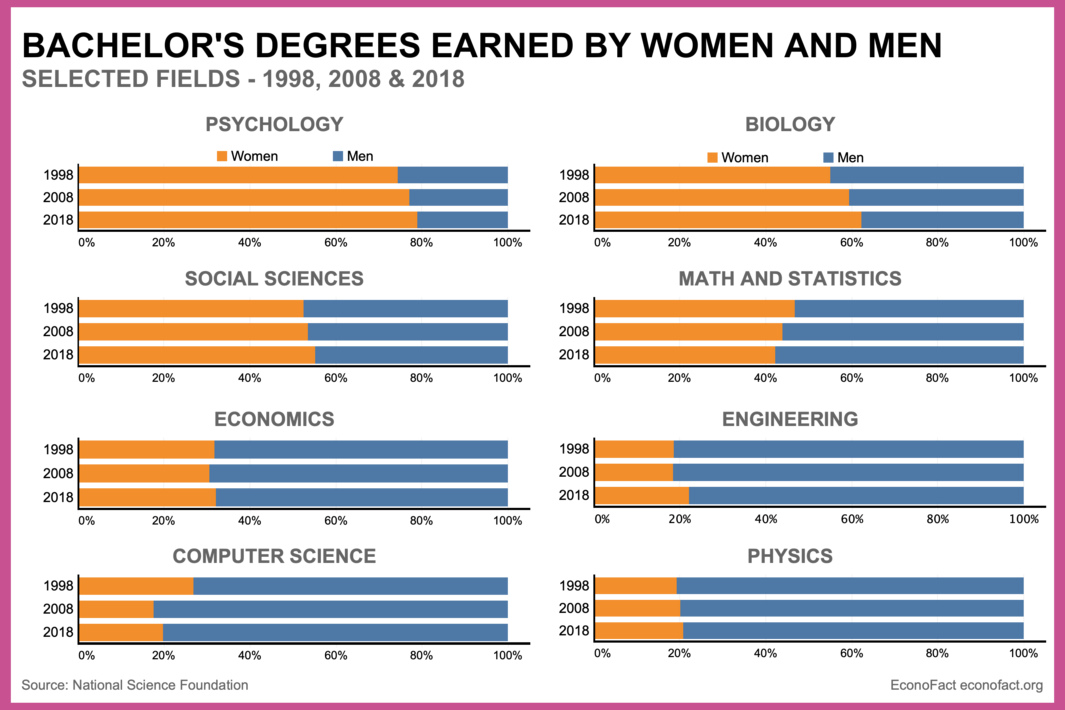
The representation of women across STEM fields varies significantly by discipline, creating a nuanced picture of progress and persistent gaps. Currently, women hold approximately 26-35% of all STEM positions in the United States, with substantial variations across specific fields.
Life sciences show the most promising statistics, with women earning about 60% of degrees and occupying roughly 45% of senior research roles. This stands in stark contrast to engineering, where women earn only 23% of degrees and hold just 16% of professional positions.
Computer science presents its own challenges, with women representing approximately 30% of graduates but only 26% of the workforce. The mathematics field shows more balance, with women consistently representing 39-44% of graduates.
The social sciences boast the highest female representation, with women comprising over 61% of professionals in the United States. These statistics reveal both encouraging trends and areas requiring focused attention.
While the overall share of women in STEM has increased from 24% in 2010 to 34% in 2025, this growth remains uneven. At the current rate, equal representation across all STEM fields isn’t projected until at least 2070—a timeline that many experts and advocates are working to accelerate.[source 1][source 2]
1
Regional Variations and Global Perspective
The picture of women’s participation in STEM varies significantly around the world. In North America, women constitute approximately 30% of the STEM workforce, while globally, the figure stands at 28.2%—significantly lower than women’s representation in non-STEM sectors (47.3%). These global disparities highlight the universal nature of the challenges women face in STEM fields while also pointing to cultural and policy differences that influence outcomes. Countries with more progressive gender equality policies generally show higher rates of female participation in technical fields.[source 3]
Breaking Down Barriers: Challenges Women Face
Women pursuing STEM careers encounter multiple obstacles throughout their educational and professional journeys. Understanding these challenges is the first step toward creating effective solutions.
1
Early Educational Roadblocks
The gender gap in STEM begins early, with societal expectations and stereotypes that can discourage girls from pursuing interests in science and mathematics. Research shows that by age six, girls are already less likely than boys to believe they are “really, really smart”—a perception that can impact their confidence in tackling STEM subjects. The COVID-19 pandemic has unfortunately deepened these educational divides, with studies showing greater science and math learning losses among girls compared to boys during school disruptions. These early disadvantages create ripple effects that influence career choices and opportunities down the line.[source 4][source 2]
2
Workplace Challenges and Retention Issues
-
Unconscious bias and discrimination in hiring, evaluation, and promotion processes -
Pay disparities that persist across most STEM disciplines -
Limited access to mentors and role models who can provide guidance and support -
Work environments that may not accommodate work-life balance needs -
Cultural isolation in male-dominated teams and departments
These factors contribute to a troubling retention problem—while women now earn about 45% of STEM degrees, they represent a much smaller percentage of mid-career and senior professionals.[source 5]
Success Stories: Women Leading the Way
1
Pioneers and Trailblazers
Today’s women in STEM stand on the shoulders of pioneers like Marie Curie, who became the first person to win Nobel Prizes in two different scientific fields, and Katherine Johnson, whose mathematical calculations were crucial to NASA’s early space missions. Modern trailblazers include figures like Dr. Jennifer Doudna, who co-invented CRISPR gene editing technology, and Dr. Fei-Fei Li, who has revolutionized the field of artificial intelligence while advocating for diversity in tech. These women have not only made groundbreaking contributions to their fields but have also actively worked to create more inclusive environments for the next generation of female scientists and engineers.[source 6]
2
The Power of Community and Mentorship
Many successful women in STEM emphasize the importance of supportive communities and mentorship networks. Organizations like Women in Science and Engineering (WISE), Society of Women Engineers (SWE), and Girls Who Code have created valuable support systems that connect women across career stages. These networks provide mentorship, professional development, and a sense of belonging that can be crucial for women navigating male-dominated environments. Research shows that women with access to mentors and supportive professional communities are more likely to persist in STEM careers and reach leadership positions.[source 7]
Strategies for Success: How to Thrive in STEM
1
Educational Foundations
Building strong educational foundations is essential. This includes:
-
Pursuing rigorous coursework in mathematics and sciences throughout K-12 education -
Exploring undergraduate research opportunities to gain hands-on experience -
Seeking out internships and co-ops with STEM-focused organizations -
Developing technical skills through both formal education and self-directed learning
Many universities now offer specialized programs and scholarships specifically designed to support women in STEM disciplines, providing financial assistance and community support.[source 8]
2
Professional Development and Advancement
As women progress in their careers, focused professional development becomes increasingly important:
-
Cultivate a strong professional network both within and outside your organization -
Find mentors and sponsors who can provide guidance and advocate for your advancement -
Develop leadership and communication skills alongside technical expertise -
Negotiate effectively for compensation, resources, and opportunities -
Consider entrepreneurship as a path to creating change and leading innovation
Women who successfully navigate STEM careers often credit their ability to advocate for themselves while building strong professional relationships as key factors in their advancement.[source 9]
The Future Outlook: Trends and Opportunities
1
Growing Demand and Changing Culture
The demand for STEM professionals continues to outpace supply in many sectors, creating opportunities for women to fill critical roles. Industries are increasingly recognizing the value of diverse teams in driving innovation and solving complex problems. Many leading technology and science-focused organizations have implemented targeted diversity initiatives, including recruitment programs, return-to-work opportunities for women who have taken career breaks, and policies designed to create more inclusive workplace cultures. If current trends continue, women could occupy nearly 38% of STEM roles by 2030, representing significant progress toward gender balance in these fields.[source 10]
2
Emerging Fields and Interdisciplinary Opportunities
Some of the most exciting opportunities for women in STEM lie in emerging and interdisciplinary fields where established gender norms may be less entrenched:
-
Artificial intelligence and machine learning -
Sustainable energy and environmental sciences -
Biomedical engineering and health informatics -
Cybersecurity and data privacy -
Human-centered design and technology
These areas often benefit from diverse perspectives and approaches, creating natural opportunities for women to lead and innovate at the intersection of multiple disciplines.[source 11]
Your Questions Answered
Q: What fields within STEM currently have the highest representation of women?
A: The life sciences and social sciences have the highest representation of women, with women comprising approximately 45-60% of life sciences graduates and 61% of social sciences professionals in the United States. Mathematics also shows promising representation, with women consistently making up 39-44% of graduates.
Q: What strategies have proven most effective for increasing women’s participation in STEM?
A: The most effective strategies include early educational interventions that engage girls in STEM subjects, robust mentorship programs connecting women across career stages, and institutional policies addressing workplace culture and unconscious bias. Organizations with comprehensive approaches that tackle multiple barriers simultaneously tend to see the strongest results.
Q: How can women best prepare for successful careers in STEM fields?
A: Building strong technical foundations through education is essential, as is developing networking and self-advocacy skills. Seeking out mentors, participating in professional organizations for women in STEM, and pursuing internships and research opportunities can provide crucial advantages. Cultivating both technical expertise and leadership capabilities creates the strongest foundation for long-term success.
Embrace Your STEM Journey
The path for women in STEM fields continues to evolve, with both persistent challenges and expanding opportunities. While representation remains uneven across disciplines, the overall trend shows steady progress toward more inclusive and diverse STEM workforces. Each woman who pursues and persists in these fields helps reshape perceptions and creates new possibilities for those who follow.
The contributions of women in STEM extend far beyond statistical representation—they bring essential perspectives to scientific discovery, technological innovation, and the solving of complex global challenges. As barriers continue to fall and support systems strengthen, the future holds tremendous promise for women seeking to make their mark in science, technology, engineering, and mathematics.
“
“At Chic & Charm, we believe every woman deserves to see herself represented in the cutting-edge fields shaping our future. Your brilliant mind belongs in STEM—not despite being a woman, but because your unique perspective is exactly what these fields need. Step confidently into the lab, the engineering team, or the research department knowing you’re not just pursuing a career, but helping create a more innovative and inclusive tomorrow.”